Signature Analysis and Personality: What Your Signature May Mean
Tips for a Positive Signature
A signature is more than a way to approve documents. Signature Analysis and Personality explores how this personal mark may represent our identity, self-image, and the way we present ourselves to the world.
In traditional graphology, the signature is often studied as a symbol of identity and self-image. Many graphologists compare it to a personal logo because it is unique to each person.
Your signature can change over time. Changes may reflect personal growth, new experiences, confidence, or changes in the way you see yourself.
This is why your signature can be an interesting part of handwriting analysis.A good signature should also be practical. It should feel comfortable to write and remain easy to use in everyday situations.
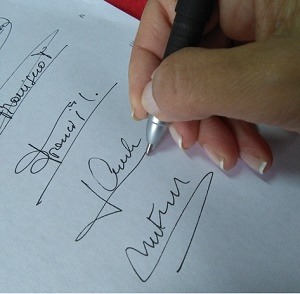
What Does My Current Signature Say?
Have you ever looked at your signature and wondered what it says about you?
You may also ask:
- Is my signature easy to read?
- Does its size match my handwriting?
- Does it look simple or complicated?
- Where do I place my signature on a page?
- Does my signature look similar to my normal handwriting?
Traditional graphology uses these features to study possible personality patterns.
However, graphology is an interpretive practice rather than a scientifically established method for measuring personality. The interpretations below should therefore be viewed as traditional graphology concepts, not medical or psychological diagnoses.
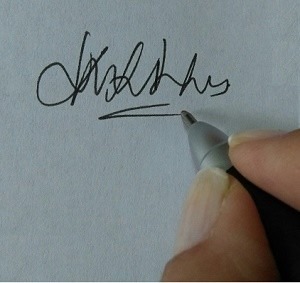
Signature Analysis: Personality, Text, and Signature
In graphology, both handwriting and the signature can provide different types of information.
Graphologists commonly examine features such as: Layout, Shape, Size, Slant, Speed, Continuity, Pressure, Spacing, Signature placement.
The written text is often considered a representation of how a person behaves and communicates with others. The signature, on the other hand, is traditionally associated with identity and self-image.
For this reason, graphologists usually prefer to study the signature together with the person’s handwriting. A signature can also change throughout life. People often develop new writing habits as they gain experience and maturity.
Common Questions About Signature Meaning
People often have questions about unusual or difficult-to-read signatures.
For example:
- What does an illegible signature mean?
- What does a dot at the end of a signature represent?
- What do initials or capital letters mean?
- What can a signature between parallel lines suggest?
- Which signature styles should you avoid?
Traditional graphology considers several features before reaching an interpretation. Looking at the complete signature is usually more useful than focusing on one stroke alone.
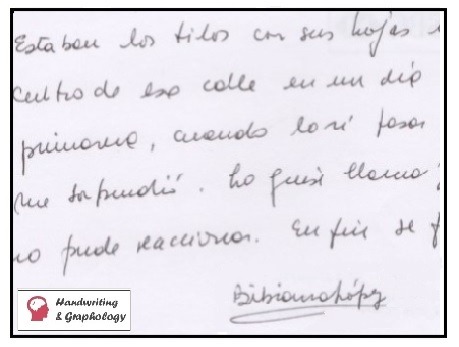
What Makes a Positive Signature?
A positive signature should first be practical and comfortable to write.
In traditional graphology, several features are commonly considered when studying a signature.
1. Capital Letters
Many graphologists prefer the first letters of the name and surname to stand out clearly.
A larger initial can create visual emphasis and make the signature easier to recognize.
2. Signature Size
The signature should have a balanced relationship with the person’s normal handwriting.
A very large or very small signature may create a strong visual difference from the rest of the writing.
3. Simple and Clear Strokes
A signature does not need complicated strokes to look elegant.
Simple, confident, and well-connected strokes can create a professional appearance. A signature with too many unnecessary loops or crossings may become difficult to reproduce.
4. Comfortable Writing
A good signature should be easy to write repeatedly.
This is especially important for professionals who sign documents regularly.
Key Features Used in Signature Analysis
Traditional signature analysis often considers these five areas:
- Signature size
- Relationship between signature and handwriting
- Legibility
- Shape and stroke patterns
- Signature location
Each feature can have different interpretations depending on the complete handwriting sample.
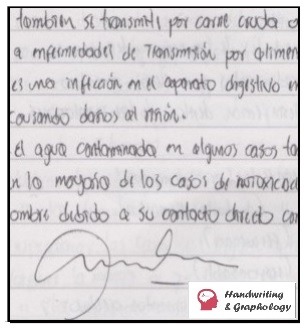
Graphology: Signature Size
Signature size is commonly studied by comparing the height and width of the signature with the person’s normal handwriting.
Traditional graphology often connects signature size with self-image and confidence.
Signature Larger Than the Text
A signature that appears much larger than the normal handwriting is traditionally associated with a strong desire for recognition or a high level of self-expression.
Some graphologists may also associate an unusually large signature with pride or an inflated sense of self.
These interpretations should always be considered together with other handwriting features.
Signature Similar in Size to the Text
When the signature and handwriting have a similar size, traditional graphology may interpret this as a balanced relationship between private identity and social presentation.
The person may appear comfortable with the way they present themselves.
Signature Smaller Than the Text
A signature that is significantly smaller than the handwriting may traditionally be associated with modesty, reserved behavior, or lower self-confidence.
However, writing habits and personal preference can also influence signature size.
Signature in Capital Letters
A signature written mainly in capital letters creates strong visual emphasis.
Traditional graphology may associate this style with a desire to appear confident, important, or noticeable.
The meaning can change when other features of the handwriting are considered.
Over-Elevated Signature
An elevated signature, especially when the upper parts of letters appear unusually high, may traditionally be associated with ambition, pride, creativity, or a strong self-image.
Again, graphologists normally consider the entire writing sample before making an interpretation.

Relationship Between Signature and Handwriting
One of the important areas in traditional graphology is the relationship between the signature and the person’s normal handwriting. Signature Analysis and Personality examines how these differences or similarities may be interpreted in relation to a person’s private identity and public presentation.
When the signature looks similar to the handwriting, graphologists may interpret this as consistency between the person’s private identity and public presentation. A strong difference between the two may suggest that the person presents themselves differently in social situations. However, there can be many practical reasons for this difference. People may intentionally create a stylish signature that does not resemble their everyday handwriting.
What If the Signature and Handwriting Look Different?
A large difference between handwriting and signature is often discussed in graphology.
The signature may represent the image a person wants to project, while everyday handwriting may show their natural writing habits.
Traditional graphology may interpret a major difference as a possible contrast between self-image and social behavior. For a meaningful analysis, graphologists generally examine the handwriting and signature together instead of studying the signature alone.
Legibility in Signature Analysis
What Is a Legible Signature?
A signature is considered legible when the name or surname can be recognized without much difficulty.
In traditional graphology, a readable signature may be associated with clarity, confidence, and a straightforward approach. From a practical point of view, legibility can also make a signature easier for others to recognize.
Semi-Legible Signature
A semi-legible signature contains recognizable letter forms, but the complete name may be difficult to read.Traditional graphology may associate this style with speed, impatience, or a preference for quick writing.
However, writing speed and professional habits can also affect legibility.
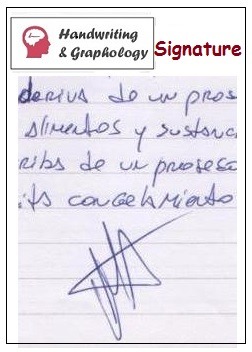
Illegible Signature
An illegible signature contains strokes that make the letters difficult to identify. Traditional graphology gives several possible interpretations to this style. Some graphologists associate it with privacy, independence, quick decision-making, or a desire to keep personal information less visible.
The context matters. A person who signs many documents every day may naturally develop a faster and less readable signature.
Graphology: The Shape of a Signature
The shape of a signature is another common feature in traditional graphology. Signature Analysis and Personality considers how different shapes and strokes may be interpreted as part of a complete signature. Graphologists may examine whether the signature contains more:
- Curves
- Angles
- Arches
- Garlands
- Thread-like strokes
- Straight lines
The overall pattern is usually more important than one individual stroke.
Signatures With Many Angles
A signature with many angles may traditionally be associated with determination, independence, strong personal energy, or a direct approach.
In some cases, graphologists may also associate excessive angularity with rigidity or resistance to change. Angles are not automatically negative. Their meaning depends on the complete signature.
Signatures With Curves
Curved signatures are often associated with flexibility, friendliness, sociability, and emotional expression in traditional graphology.
Smooth curves can also give a signature a softer and more elegant appearance.
Signatures With Arches
Arches can appear in letters such as m, n, and h.
Traditional graphology may associate prominent arches with self-protection, social awareness, or a preference for conventional behavior.
Garlands
Garland-shaped strokes are often associated with openness and sociability in traditional graphology.
They may create a softer and more welcoming visual style.
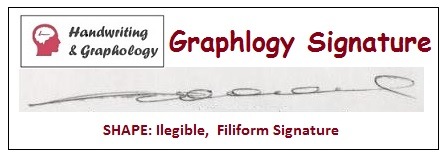
Filiform Signatures
Filiform signatures contain strokes that look like a thin or stretched thread.
Traditional graphology may associate these signatures with adaptability, diplomacy, and the ability to find solutions in difficult situations.
Signature Location and Its Meaning
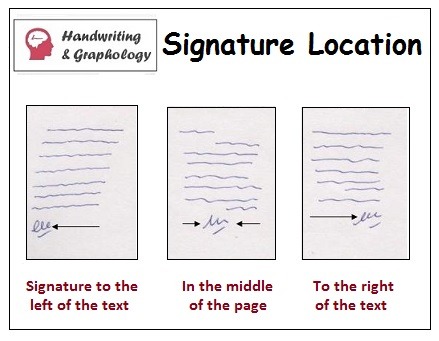
Where you place your signature on a page can also be studied in traditional graphology. Signature Analysis and Personality considers the position of the signature in relation to the written text, as placement may offer additional insights into traditional personality interpretations. Common positions include:
- Left of the text
- Right of the text
- Close to the text
- Far from the text
- Overlapping the text
- In the center of the page
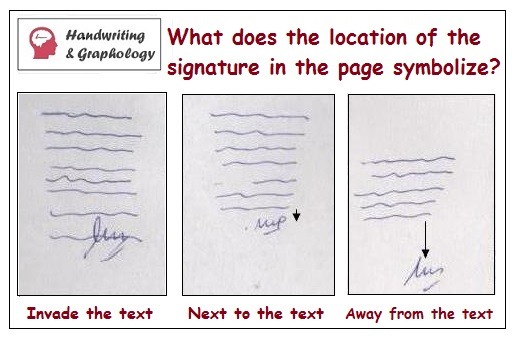
Signature Far From the Text
A signature placed far from the written text may traditionally be associated with privacy, emotional distance, independence, or a preference for personal space.
Signature That Invades the Text
When the signature overlaps or enters the written text, traditional graphology may associate it with strong self-expression, impulsiveness, or a desire to make an impact.
Other handwriting features should also be considered.
Signature Next to the Text
A signature placed close to the text may traditionally suggest sociability and an easy connection with the surrounding environment.
Signature on the Left
A signature positioned toward the left side of the text may traditionally be associated with introversion, caution, insecurity, or attachment to the past.
Signature on the Right
A signature placed toward the right may traditionally be associated with optimism, initiative, activity, and an interest in future opportunities.
Signature in the Middle
A signature placed near the center of the page may traditionally suggest self-control, caution, reflection, and balanced expression.
The complete handwriting sample is important because signature location alone cannot provide a complete interpretation.
Types of Signatures to Avoid
A signature should be attractive, practical, and easy to reproduce. From a design perspective, avoid unnecessary:
- Crossings
- Corrections
- Complicated loops
- Heavy black areas
- Random lines
- Excessive overlaps
- Difficult-to-repeat strokes
Traditional graphology may give these features additional interpretations. However, from a practical signature-design perspective, the main goal should be clarity, confidence, consistency, and ease of writing.
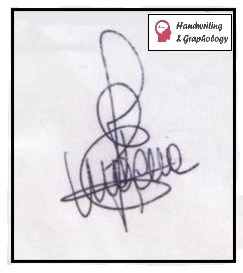
Complicated Signatures
A complicated signature contains many unnecessary strokes, loops, or crossings.
Such a design can take longer to write and may become inconsistent over time.
For professional use, a simpler signature is often easier to reproduce.
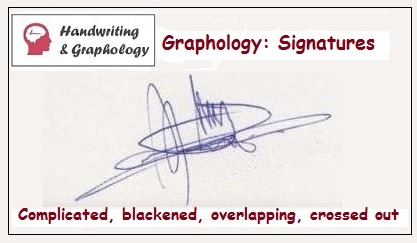
Overlapping Signatures
An overlapping signature contains strokes that cross or cover important parts of the name.
Traditional graphology may study these overlaps as part of personality interpretation.
From a design perspective, excessive overlap can reduce clarity and make the signature harder to reproduce.
Understanding the Name and Surname in a Signature
Traditional graphology may also study the different parts of a signature.
The first name is often associated with personal identity and private life.
The surname is traditionally associated with family identity, social identity, and professional life.
When one part is much more prominent than the other, graphologists may explore what this difference could represent.
However, these interpretations are not fixed rules. Cultural background, writing habits, and personal preference can influence how someone creates a signature.
Overlapping Name and Surname
Sometimes the surname overlaps the first name, or the letters of the two names become strongly connected.
Traditional graphology may interpret this as an interaction between personal and family identity.
The meaning can change depending on which part of the signature overlaps the other.
Blackened Signatures
A blackened signature contains heavy strokes or repeated marks that create dark areas.
Traditional graphology may associate this pattern with emotional tension or internal pressure.
However, a dark signature can also result from the type of pen, writing pressure, or repeated practice.
Name More Prominent Than Surname
When the first name is much more prominent than the surname, traditional graphology may associate it with a stronger focus on personal identity or private life.
Other signs should be examined before drawing any conclusion.
Surname More Prominent Than Name
When the surname dominates the signature, traditional graphology may associate it with a stronger focus on professional, family, or social identity.
Again, this is only one possible interpretation.
What Should You Avoid When Signing?
Several signature styles may create practical problems.
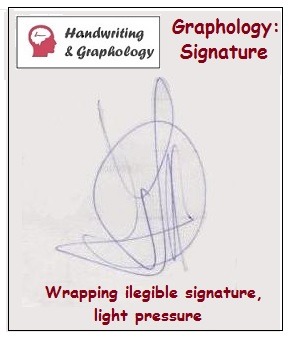
Signatures With Very Light Pressure
A very light signature can be difficult to reproduce consistently.
Traditional graphology may associate light pressure with sensitivity, reserve, or low energy. However, pen type and writing surface can also affect pressure.
Signatures With Corrections
Repeated corrections can make a signature look uncertain.
A professional signature should ideally flow naturally without frequent changes or retracing.
Regressive Signatures
A regressive signature contains strokes that move strongly toward the left.
Traditional graphology may associate these movements with attachment to the past, hesitation, or difficulty adapting to change.
The relationship between the signature and the normal handwriting should be considered before making an interpretation.
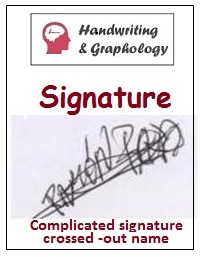
Crossed-Out Name Signatures
A signature with strong lines crossing through the name can look complicated and difficult to read.
Traditional graphology may associate this pattern with self-doubt, insecurity, or inner conflict.
From a design perspective, crossed-out strokes can also reduce the professional appearance of the signature.
Wrapping Signatures
A wrapping signature surrounds the name with a loop or enclosing stroke.
Traditional graphology may associate this pattern with a desire for protection, privacy, or personal boundaries.
From a practical perspective, excessive wrapping can make the signature slower and harder to reproduce.
Descending Signatures
A descending signature moves noticeably downward as it progresses.
Traditional graphology may associate this movement with low energy, pessimism, tiredness, or reduced confidence.
However, temporary fatigue, writing position, or the writing surface can also influence the direction of a signature.
Unnecessary Dots
Some signatures contain dots that do not belong to any letter.
Traditional graphology may associate an extra dot with caution, checking behavior, or a desire for precision.
The meaning depends on the complete handwriting pattern.
Signatures Between Parallel Lines
Some people create a signature with lines above and below the name.
Traditional graphology may interpret these lines as a desire for structure, security, discipline, or protection.
From a design perspective, these lines should remain simple enough to reproduce consistently.
Final Thoughts on Signature Analysis and Personality
Your signature is a unique part of your personal identity and can also become an important part of your personal brand.
Traditional graphology offers many ways to study signature size, shape, legibility, pressure, direction, and placement. However, no single feature should be used to judge a person’s complete personality.
If you want to create a professional signature, focus on more than appearance. A good signature should be:
- Easy to write
- Comfortable to repeat
- Visually balanced
- Distinctive
- Professional
- Suitable for everyday use
A thoughtfully designed signature can give you a consistent personal mark for documents, professional communication, and personal branding.
This concludes our guide to Signature Analysis and Personality. Share this article with anyone interested in graphology, handwriting, or signature design.